
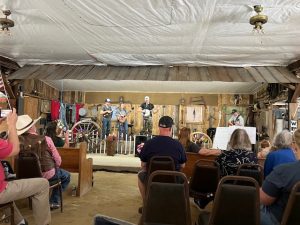
We pulled off the highway and onto a dirt road that wove its way along lush green turf. Parked cars surrounded the Edmonds Music Barn. We could hear strumming guitars as we made our way, bearing a dozen cookies, to the side entrance. There we added them to tables already piled high with crock pots and platters holding everything from baked goods to cheese to fruit. While my son paid a few dollars to the cashier, friends greeted us and soon we found empty chairs just behind theirs. Music was already playing in this Bluegrass Scramble.
Nine bluegrass bands signed up for this contest in which their members were scrambled into other groups, so each musician would perform with strangers. They had an hour to name their group, select and practice what they would play. Later, the audience voted on things like the niftiest band name or the best performance, among other things.
Now it’s been a long time since I played the piano in formal recitals. The last debacle was when I was 17 and about to graduate from the Eastman School of Music’s Preparatory Department. I was to play Schubert’s Impromptu without music. After playing the first few pages, the notes just left me. Hoping to overcome the mental block and finish the performance, I went back to the beginning for a running start. Didn’t work. Walked away from the piano and never played in another recital.
So you can imagine how amazed I was at musicians who could perform something without music that they hadn’t prepared, and with only an hour to practice. Not only that, having abandoned the piano in my old age for guitar, where I struggle to find middle C on that thing, their technique—especially at presto tempo—impressed me. Even young teens set those banjos, mandolins, guitars, and upright basses on fire.
I have always loved folk music. Fortunately, it was popular in the sixties when I was young, and I still think many of the compositions written then will stand the test of time. But what I appreciated most was folk music not written down, never to make the top ten, but passed on from one generation to another. It told of hardscrabble life in the Appalachian woods and mountains. Of love gained, love lost, joy, and everyday life. It’s music of people of mostly Scotch, Irish, and English descent, and frequently in a minor key (or mode), known as “mountain minor.”
Between the down-home cooking, barn-turned-theater, uniquely American music, and friendly folks, I’ve learned to appreciate what makes each part of America special. Our nation is a blend of cultures united by people with welcoming hearts and talent galore.

Sue, with your words I could just visualize this! Folk music is still my favorite, too; Bob and I were fortunate enough to see Gordon Lightfoot at our Civic Center, several years before his death. Your venue in Tennessee would have been even more appropriate for him! Never forget our rendition of “Michael Rode the Boat Ashore, Hallelujah!” on our bus trips to LeMoyne!!!
Great memories, Cathy! Cone on down – more Bluegrass awaits!